
Phasing
How do you phase a villa renovation in Dubai?
Splitting a villa into stages spreads the cost and keeps part of the house in use. It also multiplies approvals, deposits and access passes. Here is how to cut the job so each stage stands on its own paperwork.
Stages
How to phase a villa renovation: where should the cuts go?
The simplest way to phase a villa renovation is to cut it where the approvals already cut it. Work that needs no permit, work that needs the developer's consent, and work that needs a consultant and an authority permit each move at a different speed. Mix them in one stage and the whole stage waits for the slowest paper.
How do I phase a villa renovation?
Group the work by the approval it needs, then by the part of the house it closes off. Structural and service work goes first and together, because a later stage should never have to open a wall that has just been finished. Cosmetic stages follow room by room; on Dubai Municipality land painting, floors, doors and suspended ceilings need no permit. Then keep each stage inside the life of its approval: Dubai Holding gives approved works six months to finish.
What goes into the first stage?
Everything that is hard to undo. Walls that move, new openings, an extension shell, and the services buried in walls and floors: rewiring, re-piping and air-conditioning runs. On Dubai Municipality land this is the stage with a consultant, drawings and inspections, since the Municipality inspects an extension's foundations and each slab through Dubai BPS before the next stage can close them in.
It is also where the paperwork for the services is produced. In Abu Dhabi, any extension or alteration of a villa's electrical installation ends with an amended Electrical Installation Certificate from the licensed contractor, with one original for the owner. A later cosmetic stage can then start from a certified installation instead of reopening it.
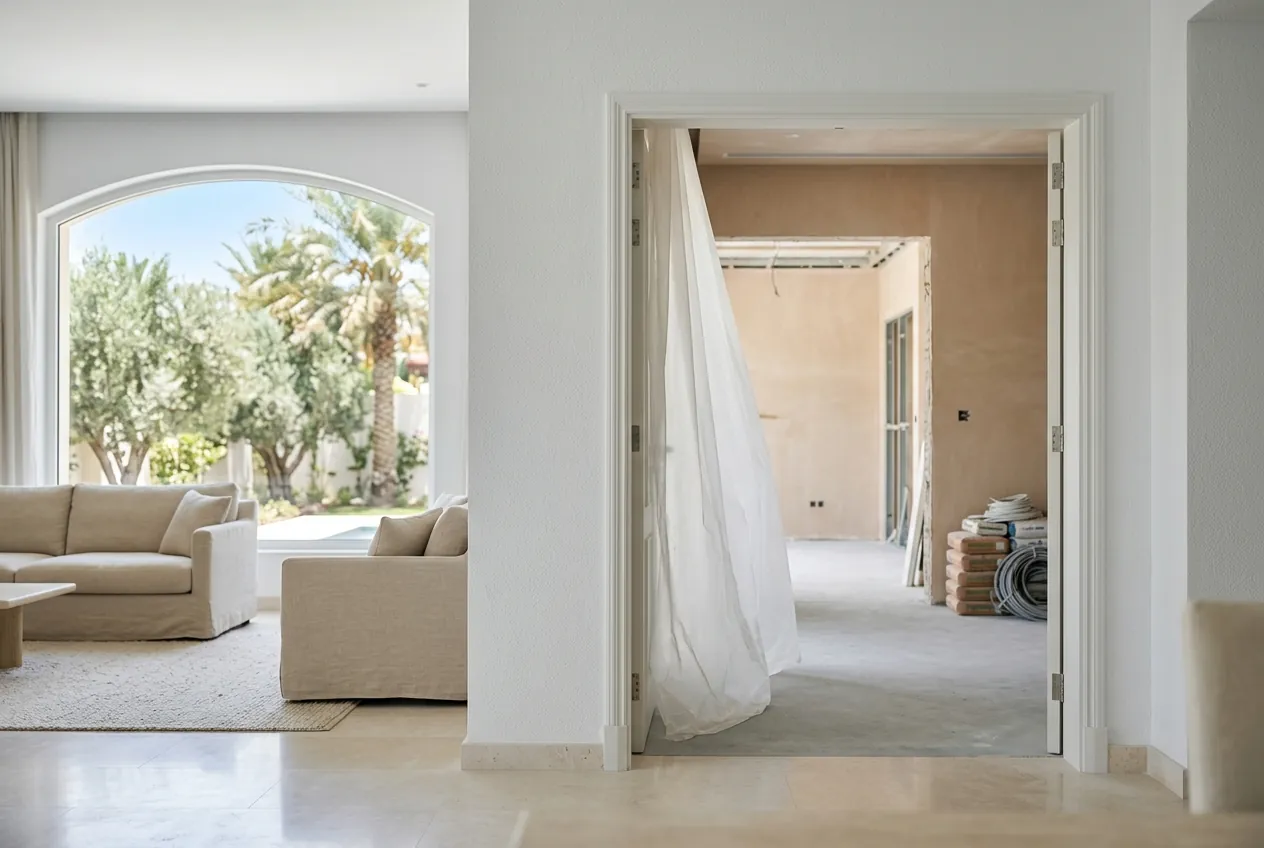
Phasing a villa renovation: what each extra stage costs
Approval fees are charged per application, so a job split into three stages that each need consent can pay three times. These are the published figures that multiply with the number of stages.
| Community or authority | Charged per application or permit | Published amount |
|---|---|---|
| Emaar | Minor or major works NOC | AED 1,000 or 2,000 in total, including the AED 500 review fee |
| Emaar | External painting, paving or soft landscaping NOC | AED 100 |
| Nakheel | Access permit per worker, for NOC-grade work | AED 52.50 per person |
| Town Square | Major, minor or home improvement tier | AED 2,000, 1,000 or 160 |
| Town Square | Deposit on a major alteration | AED 5,000 |
| Tilal Al Ghaf | Review of alteration plans | AED 5,000 plus AED 250 VAT |
| Dubai Development Authority | Permit renewal, per three months | AED 200 |
| Town Square | Contractor vehicle pass, one month to one year | AED 160 to 1,050 |
Access passes run on the calendar too: a job that stretches from one month to a year moves a Town Square contractor from the AED 160 pass to the AED 1,050 one. Against that, phasing spreads the payments and keeps part of the house in use, which is often the reason to phase at all. The trade-off is worth pricing before deciding, and we ask contractors to quote a phased job both ways, as stages and as one programme.
Which stages need no paperwork at all?
The cosmetic ones, in most communities, and they can be slotted in whenever the budget allows. Which jobs need neither a permit nor an NOC, community by community, is set out on our villa permit page. Two timing details decide how those light stages are sized. In Dubai Holding communities a job finished in a single day runs on same-day access, while anything longer needs a Minor Modifications Permit that lasts 7 days unless extended in writing, so a cosmetic stage of two weeks means an extension. In Emaar communities every contractor needs an entry permit even when no NOC does.
When does phasing cost more than it saves?
- When each stage needs its own consent. The fees above repeat, and so does the waiting time for each approval.
- When approvals lapse between stages. A DDA modification design expires after six months, and a Trakhees Modification Permit needs revalidating if the work has not begun within six months.
- When the status report goes stale. Nakheel's Villa Status Report records the villa on the day it is issued, so a long gap before an extension means requesting a fresh one.
- When deposits sit longer. On Nakheel land the contractor's deposit comes back only with the Trakhees completion certificate and a clean status report, so every idle month is money held.
- When summer lands on the outdoor stage. The midday break from 15 June to 15 September slows roofs, facades and gardens.
Living in the villa between stages
Hand each stage back properly before the next one begins: a walk-through, a written snag list and, on Trakhees land, the Modification Completion Certificate before the space is used again. Keep the work zone sealed from the rooms in use; Dubai Holding's rules ask for polyshade screening against dust and noise. Pay by stage as well, each payment tied to something you can check, as our stage payments guide sets out.
A phased job starts from one written brief that names the stages, the order and the rooms in use during each, so every contractor prices the same plan.
Questions
Phasing: related questions
- Can I renovate one floor at a time?
- Yes, if each floor's work stands on its own paper. Services that run between floors, such as risers and air-conditioning ducts, belong in the first stage, so the second floor never has to reopen the first. On Trakhees land each floor's modified space waits for its completion certificate before it is used.
- Does each phase need a new contractor?
- No, and one contractor for every stage keeps one set of access passes and one warranty. Separate contractors each need their own entry permits or gate passes, and in Nakheel communities each appointed contractor applies for its own site-access NOC.
- How should payments work in a phased job?
- Stage by stage, each payment tied to something you can check: the permit issued, the inspection passed, the stage's snag list closed. Keep a final payment on every stage rather than one at the very end of the whole project.
- Does Emaar approve a renovation in phases?
- Each alteration needs its NOC before work starts, and minor and major works are processed in 3 business days, so a phased job applies for each stage's scope when that stage is ready. The NOC has to be on display at the site while the stage runs.
- What should the brief say for a phased renovation?
- The stages, their order, which rooms stay in use during each, and whether the contractor prices the stages together or one at a time. We ask for both, so the cost of phasing is visible before you commit to it.
Who you are dealing with
- OperatorWebsiteOS LLC
- Licence2646567.01
- Cost to homeownerNone
- Figures datedSeptember 2026
Tell us how you want to stage it
Community, villa size, the work and which rooms must stay in use. We come back with quotes priced by stage and as one programme.